It has been oft repeated that "content is king!"
So, if that's the case, why do people consistently try to get their content for free or on the cheap?
So many in Digital Signage and DOOH are systems focused, and so very, very few focused on content production, production values, message, and message strategy.
I think it's often assumed this is the responsibility of advertising agencies, and marketing "people", but if you are installing or running a network, it needs to be your focus.
The message (content) is where the value is. You can have the best hardware and software platform, the best integration, the best technical support, but if the messages suck, the whole thing sucks.
Think of a Limo without seats, steering wheel or brakes.
Content (message) truly is king, and strategy must be queen, and the DS system, can only ever be the coach and four.
So, qualified, strategic content producers are a critical part of your success equation. That is, people who know more than just how to make a pretty picture. People who can create great visual messaging designed to accomplish real business objectives.
We like Phase 3 Digital, because they're both artistic as well as digital and strategy savvy.
Serious investment must be made in that expertise, that marketing message expertise and the appropriate production values that should accompany it. If the message and strategy are great, but the visuals look like hell, the campaign will fail, and then Digital Signage and DOOH takes yet another black eye. Don't do that to yourself, to your client, and to the industry; make sure that content and strategy are the best you can get. Get the best expertise and production at the best price you can, but don't sacrifice mission-critical standards to a bean-counter's mentality.
Showing posts with label content. Show all posts
Showing posts with label content. Show all posts
Thursday, June 6, 2013


Friday, April 5, 2013
What's inside a Digital Mannequin?
I get a lot of requests for info about the Digital Mannequin, and Window Video Systems, generally.
Now, if you asked that question about a standard mannequin, it would be a very different kind of answer. Materials, structural joints, air, etc.
But a Digital Mannequin is a human representation. It is not a likeness, it is a digital leveraging of an actual person. This goes to the issue of content, concept, content creation, the interplay between tech and creative.
The question goes to the point of product (let's say, clothing) and strategically, the best way to sell that product. What model(s)? What makeup? What lighting? Background, resolution, luminosity, graphics, etc., etc. Who shoots that model? How much content do you shoot? Who selects the shots, angles, location, directs the models, on and on, you get the idea.
And what is the strategic concept for the display? Display only, or display and promo? What is the offer and how is it offered? What graphical style, font, size, color, other effects?
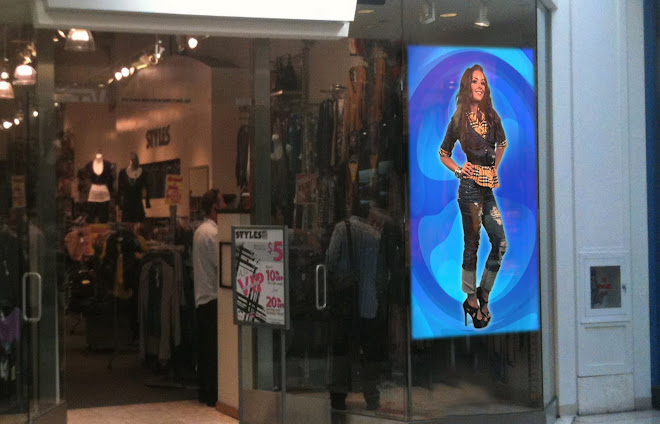
The photo at the top of this page shows an actual model, who was part of a shoot featuring 4 models, multiple costumes, wardrobe personnel, makeup artist, video camera man, director of photography, myself, and several others. This is not a DIY type of project!
When people say "content is king" these issues are part of what they mean. The hardware portion of a Digital Mannequin display is only a small part of the effectiveness of DM. The screen or projection is an important but only small part of the DM display. If you don't have the expertise in those areas, you need to find that expertise. Contact me for more info about how we can provide you the best integration, effect and result from your DM display.
Now, if you asked that question about a standard mannequin, it would be a very different kind of answer. Materials, structural joints, air, etc.
But a Digital Mannequin is a human representation. It is not a likeness, it is a digital leveraging of an actual person. This goes to the issue of content, concept, content creation, the interplay between tech and creative.
The question goes to the point of product (let's say, clothing) and strategically, the best way to sell that product. What model(s)? What makeup? What lighting? Background, resolution, luminosity, graphics, etc., etc. Who shoots that model? How much content do you shoot? Who selects the shots, angles, location, directs the models, on and on, you get the idea.
And what is the strategic concept for the display? Display only, or display and promo? What is the offer and how is it offered? What graphical style, font, size, color, other effects?
The photo at the top of this page shows an actual model, who was part of a shoot featuring 4 models, multiple costumes, wardrobe personnel, makeup artist, video camera man, director of photography, myself, and several others. This is not a DIY type of project!
When people say "content is king" these issues are part of what they mean. The hardware portion of a Digital Mannequin display is only a small part of the effectiveness of DM. The screen or projection is an important but only small part of the DM display. If you don't have the expertise in those areas, you need to find that expertise. Contact me for more info about how we can provide you the best integration, effect and result from your DM display.
Thursday, January 31, 2013
What They're Not Telling You
When it comes to Visual Messages, particularly in DS and DOOH, people don't tell you when you suck.
Nobody calls you up and says, "Hey, that screen in the airport? You know the graphic with the -------, that one? It really blows. I was so uninterested, I didn't even pay attention!"
You get no feedback on ineffective messaging.
This allows for a great deal of ineffective content to flow right on our there into the space, giving your display, the location where it's deployed, anyone who works there that's close by, and of course you and your company, and the Digital Signage industry generally, A BAD NAME!
Poor visual content and method are responsible for a lot of the fails in this industry. DON'T CONTRIBUTE TO IT!
This display is a good example of bad. You'll notice that not one person even looks. The image doesn't grab you. It's very faint. When you finally do notice (which in this case, could be never,) the images don't convey anything specific or relevant. That is a bad thing for DS or DOOH. Don't blame the hardware, or the software, or the location. Blame the execution and complete lack of relevant content.
Develop campaigns that are trackable, and then work on the message. Tweak it. Don't settle for the status quo. Don't assume that it's good enough, or that the results you get are the limit of effectiveness for that campaign. With visual messaging, it's not always the proposition (or lack of one.) Sometimes it's the method or style of the visuals surrounding the message.
A great deal more attention needs to be paid to testing the effectiveness, and then understanding why certain visual messages are effective. In my view, this is an area where DOOH needs to focus a lot more attention. It's not just about the hardware, placement, software, or management. It's how that message content is put together and knowing, to the greatest degree possible why a message works or doesn't work. For that you need measurement and analysis.
You want to make money in DS? Understanding your content and why it produces the result it does is key to ensuring profitability.
Nobody calls you up and says, "Hey, that screen in the airport? You know the graphic with the -------, that one? It really blows. I was so uninterested, I didn't even pay attention!"
You get no feedback on ineffective messaging.
This allows for a great deal of ineffective content to flow right on our there into the space, giving your display, the location where it's deployed, anyone who works there that's close by, and of course you and your company, and the Digital Signage industry generally, A BAD NAME!
Poor visual content and method are responsible for a lot of the fails in this industry. DON'T CONTRIBUTE TO IT!
This display is a good example of bad. You'll notice that not one person even looks. The image doesn't grab you. It's very faint. When you finally do notice (which in this case, could be never,) the images don't convey anything specific or relevant. That is a bad thing for DS or DOOH. Don't blame the hardware, or the software, or the location. Blame the execution and complete lack of relevant content.
Develop campaigns that are trackable, and then work on the message. Tweak it. Don't settle for the status quo. Don't assume that it's good enough, or that the results you get are the limit of effectiveness for that campaign. With visual messaging, it's not always the proposition (or lack of one.) Sometimes it's the method or style of the visuals surrounding the message.
A great deal more attention needs to be paid to testing the effectiveness, and then understanding why certain visual messages are effective. In my view, this is an area where DOOH needs to focus a lot more attention. It's not just about the hardware, placement, software, or management. It's how that message content is put together and knowing, to the greatest degree possible why a message works or doesn't work. For that you need measurement and analysis.
You want to make money in DS? Understanding your content and why it produces the result it does is key to ensuring profitability.
Tuesday, November 20, 2012
Screens on the Machines
By now you've grown accustomed to the screens at the gas pump. Old news. But for DOOH people, good news. The premise is screens in high traffic areas for the purpose of creating advertising opportunities, and cash flow. I personally have not been a fan of the screens on the gas pumps so far, because the messages I have seen are useless and irrelevant to me.
But what if those messages were actually INDISPENSIBLE?!!! What if they provided me with essential information? Not weather, not a promo for a tv program, or some other lame thing. But something really important and relevant to me? Then I would probably be interested in a heartbeat. The point is not the screens or the gas pumps. The point is the CONTENT. The Message!
I am certainly not the first to beat this drum, and I won't be the last, but I will beat this drum nonetheless! DOOH has so much potential to drive traffic and sales. To promote. To inform. To sell. As DOOH providers we need to be more strategic about what we allow on our networks and our screens. I understand the need to get money in the door, but let's push for something more. Let's strategize engagement, and interactivity.
I work with a provider of content, Phase 3 Digital, that create and strategically distribute content and campaigns. We have recently brought a network of phone banks in airports online, with the first 2 of many airports, Denver and Palm Springs. Instead of pay phones, these phones provide free calls in the US and Internationally. But each phone also has a digital screen with sale-able content, as well as 5 buttons for direct connect to any client. In other words, a car rental agency can buy one of the buttons. Or a ticket company, etc. So the air passenger is walking along and needs to make a call but his cell phone is dead. He can charge his phone at this phone station while he makes a free call, and as he does so, he is facing a screen showing ads for hotels, events, destinations, offers, etc.
Bingo. Automatic engagement. Direct connection. Target audience. This is exactly the type of indispensible opportunity that DOOH must offer.
By the way, advertisers, the very first day online 2,000 people made calls on those phones!
We are also working with a vending machine company whose machines all feature video screens. Same thing: the viewer has an immediate engagement opportunity. Powerful.
Gas pumps. Airport phones. Vending machines. Store windows. Get the message out, and get engaged.
But what if those messages were actually INDISPENSIBLE?!!! What if they provided me with essential information? Not weather, not a promo for a tv program, or some other lame thing. But something really important and relevant to me? Then I would probably be interested in a heartbeat. The point is not the screens or the gas pumps. The point is the CONTENT. The Message!
I am certainly not the first to beat this drum, and I won't be the last, but I will beat this drum nonetheless! DOOH has so much potential to drive traffic and sales. To promote. To inform. To sell. As DOOH providers we need to be more strategic about what we allow on our networks and our screens. I understand the need to get money in the door, but let's push for something more. Let's strategize engagement, and interactivity.
I work with a provider of content, Phase 3 Digital, that create and strategically distribute content and campaigns. We have recently brought a network of phone banks in airports online, with the first 2 of many airports, Denver and Palm Springs. Instead of pay phones, these phones provide free calls in the US and Internationally. But each phone also has a digital screen with sale-able content, as well as 5 buttons for direct connect to any client. In other words, a car rental agency can buy one of the buttons. Or a ticket company, etc. So the air passenger is walking along and needs to make a call but his cell phone is dead. He can charge his phone at this phone station while he makes a free call, and as he does so, he is facing a screen showing ads for hotels, events, destinations, offers, etc.
Bingo. Automatic engagement. Direct connection. Target audience. This is exactly the type of indispensible opportunity that DOOH must offer.
By the way, advertisers, the very first day online 2,000 people made calls on those phones!
We are also working with a vending machine company whose machines all feature video screens. Same thing: the viewer has an immediate engagement opportunity. Powerful.
Gas pumps. Airport phones. Vending machines. Store windows. Get the message out, and get engaged.
Monday, October 29, 2012
Road to ROI
Return on Investment, or ROI, is how every investment decision in capital equipment, marketing materials, signage, is made by those who approve expenditures.
An objective is determined, a value assigned to that investment, and then some effort at due diligence in securing the best price (cost-effective) for that investment/purchase.
Someone determines that display and signage is necessary, someone identifies a budget, and then investments are made according to budget. When a new type of investment (in new technology) for signage or display comes under consideration, then the process begins anew for that particular investment. Perceived, and actual value are debated and assessed, not always from a fully-informed perspective, but usually some effort is expended in that direction.
The vendor does their best to convey the indispensability of their product; usually from a features/benefits standpoint, but not always in the terms or language that the potential investor uses. This is a key marketing and sales function:
"What will this investment do for me?" asks the potential buyer.
In the best possible scenario, the seller of the product has informed themselves diligently on the buyer's needs and valuation method, and can answer, "Here's how much this will make you/save you, over --- period of time." They articulate the value of the product in clear financial terms, and THEN restate the practical or functional values and features.
ROI gives the client/buyer the permission to invest in your product.
Window Video Systems (WVS) have clear, broad and deep ROI potential:
Display more of the client's product in a more dynamic, useful, attractive way than ever before. Never before has a retailer or business been able to display or demonstrate ALL of their products directly ON their storefront window, in full color and motion repeating the message. Never have they been able to repeat multiple or different kinds of messages, and especially, selling propositions, whether it be SALE, or pricing incentives, or other types of value propositions, or promotion of upcoming opportunities to the customer. WVS allows for interactive engagement with the viewing traffic, via QR or text to mobile device. WVS can drive traffic: both foot traffic in-store, or traffic to the Web, or to e-commerce portal. In the process, WVS can allow stores to "capture" viewers via engagement.
WVS is transformative. It has the potential to enable the retailer or other commercial business to transform how they communicate with customers with more immediacy and more depth.
Always look for ways to articulate and specify value to your OOH displays, to demonstrate ROI. It is the key to purchase approval. How does your OOH display provide ROI?
An objective is determined, a value assigned to that investment, and then some effort at due diligence in securing the best price (cost-effective) for that investment/purchase.
Someone determines that display and signage is necessary, someone identifies a budget, and then investments are made according to budget. When a new type of investment (in new technology) for signage or display comes under consideration, then the process begins anew for that particular investment. Perceived, and actual value are debated and assessed, not always from a fully-informed perspective, but usually some effort is expended in that direction.
The vendor does their best to convey the indispensability of their product; usually from a features/benefits standpoint, but not always in the terms or language that the potential investor uses. This is a key marketing and sales function:
"What will this investment do for me?" asks the potential buyer.
In the best possible scenario, the seller of the product has informed themselves diligently on the buyer's needs and valuation method, and can answer, "Here's how much this will make you/save you, over --- period of time." They articulate the value of the product in clear financial terms, and THEN restate the practical or functional values and features.
ROI gives the client/buyer the permission to invest in your product.
Window Video Systems (WVS) have clear, broad and deep ROI potential:
Display more of the client's product in a more dynamic, useful, attractive way than ever before. Never before has a retailer or business been able to display or demonstrate ALL of their products directly ON their storefront window, in full color and motion repeating the message. Never have they been able to repeat multiple or different kinds of messages, and especially, selling propositions, whether it be SALE, or pricing incentives, or other types of value propositions, or promotion of upcoming opportunities to the customer. WVS allows for interactive engagement with the viewing traffic, via QR or text to mobile device. WVS can drive traffic: both foot traffic in-store, or traffic to the Web, or to e-commerce portal. In the process, WVS can allow stores to "capture" viewers via engagement.
WVS is transformative. It has the potential to enable the retailer or other commercial business to transform how they communicate with customers with more immediacy and more depth.
Always look for ways to articulate and specify value to your OOH displays, to demonstrate ROI. It is the key to purchase approval. How does your OOH display provide ROI?
Monday, February 1, 2010
Thing One
"In the beginning was the Word..."
I don't want to in any way compare what we do to the meaning of that phrase, but from a business messaging standpoint, it is very illustrative of the importance of your message. It is the articulated word that defines an entity, or an endeavor.
If you don't have the right word or message for who or what you are, everything else suffers, often fatally.
This is why your message must be right. This is why you continue to work on it, refine it, hone it, grow it, distill it.
Because nothing valuable happens without doing that. Say what you will, do what you will, if you start with the wrong message, you are working uphill with an avalanche coming at you. Business is challenging enough as it is, with competition breathing down your neck, or worse, eating your lunch. So get your message right, and get it out there pointedly, targeted, aggressively, consistently, repeatedly. Do it right. Do it better. Do it louder. Do it more.
Subscribe to:
Posts (Atom)
