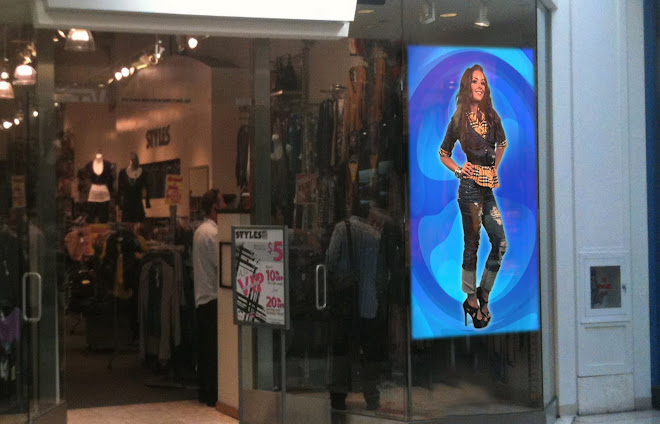
Because everyone has that. Well, not everyone, but even a big screen is just a big screen.
Window Video Systems (projected digital signage) allow for eye-popping effects, different size possibilities, customized visual formats, and most of all, a completely different effect than an installed screen.
Window Video Systems (WVS) use projection and rear projection films applied to window glass to literally turn the glass into a video screen---hence the name, Looknglas.
Businesses, especially retail, need and crave fresh, attention-grabbing content. The key to effective implementation is not hardware! (Everybody's so fixated on hardware and gadgetry---thanks Apple!)
The issue is, what do you have to say? What is the value of that message?
Invest in the message, a really good, powerful message, that is strategic and measurable. All the things I have been saying for years. Don't invest in hardware, invest in messaging to your target audience effectively, and you'll never go wrong.
Feel free to ask any questions about this system or how it can work for your business. Let's blow some minds!
He does a video blog called "Cohen on Content" http://onthecspot.com/archives/1070 dishes on all things DS and DOOH. Being a successful owner of a network himself for years, he knows a thing or two about the subject.
So I was watching his latest post, and though he takes a while to get going, he makes some great points.
Point 1: Don't think you're going to create DS content with Powerpoint. You don't want him coming after you speaking a language he knows you'll understand. (He speaks fluent baseball bat.)
Points 2-10: It's not about impressions. It's not about eyeballs. It's about making money. You have to have engagement, and a way to prove that engagement, be it third party corroboration, sales, track-able promotions, or whatever, you need to show that you are accomplishing something, preferably making money.
DS and DOOH are not about putting up a screen where you think a bunch of people will see it. It is about effectively accomplishing serious business objectives. And you don't do that by being the next DIY digital signage failure. You do it by knowing what you're doing; what hardware and software platforms are apropos to your purpose, and what content and strategy will accomplish that purpose.
Engagement is awesome. Interacting with your audience, intriguing them, interesting them, entertaining them, and... and... then what?
Many of us have gotten good at engaging through Social Media by creating or pushing relevant or interesting content. But once that's up and going, how good are you at moving beyond mere engagement to something more business related, like... wait for it... BUYING?!!! Here's a good example of engagement with audience:
This is a pretty technical display, and not cheap by any means. How much time would you see yourself spending interacting with this? Can you see yourself buying as a result?
Personally, I can't see this moving me any closer to a purchase.
Meaningful business-related engagement must be for the purpose of transacting at some point, preferably sooner than later. The average retailer couldn't dream of investing in this display long term or on a widespread basis. When the path to purchasing becomes clearer, then this type of display and technology becomes much more valuable to the retailer.
Don't get me wrong; I love this technology and attraction value, but I think it's a little disconnected from the rest of the customer experience in the clothes-buying process.
How would you revise this display to become a "customer-ing" engagement display tool? How could this be re-positioned to better encourage purchasing?
My philosophy is to use any display like this as a means to attract, engage, propose, incentivize, and motivate to purchase. But I'm kind of a fuddy-dud that way.
I get a lot of requests for info about the Digital Mannequin, and Window Video Systems, generally.
Now, if you asked that question about a standard mannequin, it would be a very different kind of answer. Materials, structural joints, air, etc.
But a Digital Mannequin is a human representation. It is not a likeness, it is a digital leveraging of an actual person. This goes to the issue of content, concept, content creation, the interplay between tech and creative.
The question goes to the point of product (let's say, clothing) and strategically, the best way to sell that product. What model(s)? What makeup? What lighting? Background, resolution, luminosity, graphics, etc., etc. Who shoots that model? How much content do you shoot? Who selects the shots, angles, location, directs the models, on and on, you get the idea.
And what is the strategic concept for the display? Display only, or display and promo? What is the offer and how is it offered? What graphical style, font, size, color, other effects?
The photo at the top of this page shows an actual model, who was part of a shoot featuring 4 models, multiple costumes, wardrobe personnel, makeup artist, video camera man, director of photography, myself, and several others. This is not a DIY type of project!
When people say "content is king" these issues are part of what they mean. The hardware portion of a Digital Mannequin display is only a small part of the effectiveness of DM. The screen or projection is an important but only small part of the DM display. If you don't have the expertise in those areas, you need to find that expertise. Contact me for more info about how we can provide you the best integration, effect and result from your DM display.
Digital Mannequin, screens in the window, digital signage a point of purchase, all should do more than display if you want return on your investment.
This video illustrates how the window display attracts attention, while larger in-store screens demonstrate specific sales promos. This method creates the excitement of dynamic motion-display, attracting customers' eyes and attention, motivating them to initial action (coming in the store,) then to buying action (promotional offer at point of purchase.) At this point, a "customering" offer can be made, text or QR coupon redeemable with the next purchase, or other reward-based promotion.
The important thing is to always include a trackable, measurable call to action. This is where creating that engaging, dynamic customer experience is possible, where the opportunity to create and strengthen a bond in one single line of messaging and action.
Powerful! And profitable. Get your systems, images and messages coordinated and keep them moving in a business-oriented direction. That's where the money is. That's where the provable power and life-pulse of Digital Signage is.
I am not a huge fan of sound with Digital Signage generally.
But being an audio guy (20 years in radio) I appreciate the value of audio communication. And I want to make one thing crystal clear: AUDIO ROCKS!!!
Who doesn't like audio? What am I, nuts?!!! Of course audio can be very effective.
My position is simply that audio is not always required, or even desirable. Billboards neither utilize nor need audio to be effective.
At the same time, in place-based DOOH messaging, many times there is already ambient audio playing. You can hardly go anywhere retail-oriented without being blasted with someone else's idea of a "good" soundtrack or radio channel. This is not only annoying, it is extremely distracting for many people, me being one.
Audio clutter can be every bit as destructive to effective messaging as visual clutter. I have always been a proponent of focused, directed messaging, without clutter.
That being said, there are definitely times when audio is not only helpful, it's critical. When you really want to grab someone's attention, use audio unexpectedly, and with a clear focused point and benefit. For example: Let's say you have a digital sign hanging in a salon window with an attractive woman modeling a hair style. If the model were to all of a sudden, look you straight in the eye, and address you, digital though she may be, it would get your attention, big time. If she then proceeded to call your attention to the fact that if you bring your wife in for a cut, you can get one for free, you'd probably strongly consider the offer!
That entire chain of events began with the disruptive and unexpected use of audio. A definite advantage. Like all strategies, when overused, it reaches a point of diminishing returns. But in small, selective, strategic doses, I like audio for DOOH. What do you think?
When it comes to Visual Messages, particularly in DS and DOOH, people don't tell you when you suck.
Nobody calls you up and says, "Hey, that screen in the airport? You know the graphic with the -------, that one? It really blows. I was so uninterested, I didn't even pay attention!"
You get no feedback on ineffective messaging.
This allows for a great deal of ineffective content to flow right on our there into the space, giving your display, the location where it's deployed, anyone who works there that's close by, and of course you and your company, and the Digital Signage industry generally, A BAD NAME!
Poor visual content and method are responsible for a lot of the fails in this industry. DON'T CONTRIBUTE TO IT!
This display is a good example of bad. You'll notice that not one person even looks. The image doesn't grab you. It's very faint. When you finally do notice (which in this case, could be never,) the images don't convey anything specific or relevant. That is a bad thing for DS or DOOH. Don't blame the hardware, or the software, or the location. Blame the execution and complete lack of relevant content.
Develop campaigns that are trackable, and then work on the message. Tweak it. Don't settle for the status quo. Don't assume that it's good enough, or that the results you get are the limit of effectiveness for that campaign. With visual messaging, it's not always the proposition (or lack of one.) Sometimes it's the method or style of the visuals surrounding the message.
A great deal more attention needs to be paid to testing the effectiveness, and then understanding why certain visual messages are effective. In my view, this is an area where DOOH needs to focus a lot more attention. It's not just about the hardware, placement, software, or management. It's how that message content is put together and knowing, to the greatest degree possible why a message works or doesn't work. For that you need measurement and analysis.
You want to make money in DS? Understanding your content and why it produces the result it does is key to ensuring profitability.
Casio just announced its new counter-top digital signage products, which, interestingly, use projection. Being a projected digital signage fan (Looknglas, Window Video Systems) I am intrigued by their product intro, and the concept.
While these little boxes may not come across that exciting, they are an interesting step in what I believe is a very good direction. Sure, the execution is not super exciting; frankly, kind of cheesy if you really want to know my opinion. But, exciting at the same time! Why? Because they represent an ongoing effort to innovate digital signage at Point of Sale, in an easy to use solution.
I do agree with Dave Haynes' (Sixteen Nine) feelings about the product from a strictly unbiased point of view. But my problem is that I am not unbiased! I am all about projection as a digital signage solution, and I am aware of the obstacles the method needs to overcome. But this is an honest effort. The solution may not be super effective, but it is a good try. I think Casio can do a lot better. The method has a very big upside.
The images and even the packaging are not there yet. But the thing to remember with any device like this is that the content and ease of use are the most important things. The design of the device itself can easily be improved.
So, while I am not enamored of this device in its current iteration, I applaud Casio for the effort, and urge them to keep at it. This is a good step in a good direction for POS merchandising, messaging and display. What do you think?
I thought it time to revisit this topic from a previous post ("Projected Digital Signage"), to check on the progress of the method.
It would appear that progress is there from a potential standpoint, but not in terms of actual use. Let me break it down:
Progress: Components and system software/management continue to improve with prices coming down. More companies appear to be showing interest in Digital Signage, especially for retail Point-of-sale (POS), and coming out with newer, more versatile components.
A lot of interest has been paid to touch screen technology as it relates to engagement.
The projector industry continues to advance; they have all the capabilities, but they don't seem to be focusing on their product so much as a primary element of digital signage, though more and more seem to be factoring that possibility into their design and features.
We have come up with a solution for the issues of direct sunlight and refracted glare, especially from multiple sources. Since glare can play havoc with any projection or other screen behind glass, (such as a store window,) this is a significant step.
More and more people continue to express and demonstrate interest in the method, trying it out, but not a lot of long term installs yet. This should change as we demonstrate lower cost of ownership, and higher value of use.
Needs Improvement: Pricing needs to come more into line with a level more accessible on a widespread basis.
Most implementations are temporary, and isolated. To date, I am not aware of any chain which has adopted projected signage across their brand.
Although the method has been used to create "engagement", that engagement has been mostly on a gimmicky, "look what we can do" basis, but not in a functional, ROI-based way to engage the viewing audience for the purpose of directly doing business. This is a key change that needs to occur. So far most installs have been strictly for display. The method needs to be adapted to more transaction-based purposes, for promotion, and especially sales.
More attention needs to be paid to content production specific to the method, and specific to ROI-based objectives.
Below is an example of a WVS implementation with some of the problems I point out:
Although the method has undeniable coolness, its viability for business will not come to fruition until these issues are resolved.
Overall, projection systems for retail have not made the jump to serious, affordable, long-term business solution. I believe that chasm can be crossed, but the issues mentioned above need to be addressed.
At Looknglas, we have addressed these issues. When the marketplace comes to grips with the reality that these systems are not widgets, but rather, serious communications and POS marketing solutions, the Window Video System will have arrived.
The Window of Opportunity is here: the problems have been solved by Looknglas. Let us help you develop your POS window display and promo system for true, measurable ROI.
Projections in store windows are attention-grabbing. It's one of the most exciting display methods available in the market today.
Except when you can't find someone to install one for you.
Except when you realize that having exciting images is something you have to pay for.
Except when you discover that not all video content is created equal.
Except when you discover there is more to buying a projector than you realized.
Except when you discover that there's more to installing that projector than you realized.
Except when you discover that most projectors are rather expensive to own, especially replacing their lamps every few months (because you wanted to actually USE your window video system every day!
Except when you realize that someone has to turn the system on and off every day.
Except when you realize that someone (you) has to come up with the design and flow of the visual content so that it's not just the same darn thing everyday, all day.
Except when you realize that finding a rear projection screen provider (in your area) is not that easy.
Except when you realize that finding and putting all this stuff together is ----ing expensive!!!
Except when you realize that finding the right hardware/software system to more easily manage your system is time-consuming and expensive!
Except,
Except,
Except.....
The purpose is not to discourage you. Take heart! We have figured all of this out for you. Window video systems by Looknglas are:
Affordable
Easy to install
Low (hardware) maintenance
Easy to use (we create and manage your messages for you!)
Green (enviro-friendly, saving paper, no lamp replacement, low energy consumption, no mercury in the lamp.)
Flexible
Powerful (able to display virtually unlimited images and messages!)
Awesome and exciting (see Digital Mannequin and Oakley Store videos.)
The possibilities are endless for retail display, in particular. Designers and Visual Merchandisers are adapting and adopting. The ability to show whatever you want, when you want, and change or add to the messaging is an absolute game-changer. So much so, that even the bigger chains are looking at it, and talking about implementing. (See article below.)
Customer experience, featuring interactivity (most commonly touch) is the coming thing in the retail industry. And rightly so.
Brick and mortar retail has the advantage over online retail in that they can provide a superior experience. After all, online can only provide so much, and all of it "virtual". But brick and mortar can provide "real" and people are hungering for ever more "real" experiences. Actual engaging interaction at the Point Of Sale (POS) is a huge distinction and advantage that the brick and mortar store can offer. Apple stores, Microsoft stores, AT&T's new interactive store, and even places like Cabela's and Bass Pro Shops are all great examples of retail POS engagement. The places that do it really well are destinations. You love going there. They keep it real and relevant.
Digital Signage can assist greatly in this POS engagement. Text campaigns, QR campaigns, Social Media campaigns, even simple signage promo campaigns that drive the viewer to interact in some distinct way with the store, its product or its personnel are all strategies that need to be employed via digital signage. Please don't stop with mere signage messaging; get that powerful DS or DOOH system working to engage people, especially customers, to add value, to enhance that vital (personal) business relationship. Every personal interaction you create enhances the relationship in so much more powerful a way than a "like" or a share.
You have the tools; step out of the box, figuratively and literally. Work on new ways to use your DS, especially Window Video Systems, to engage!
Some ideas are just a wee bit ahead of their time. If you're a techno-geek/gadget fan, if you scour Mashable daily for cool new technology breakthroughs and products, if you're always looking for the next new cool thing, then you already know this: Technology always far outstrips the marketplace's willingness or ability to adopt. That may never have been truer than today, with a worldwide recession keeping a damper on things, at the same time as unprecedented tech advances continue to come around the bend.
This blog being about DOOH generally, and Window Video Systems (projected digital signage) in particular, I am pleased to announce that the reasons why WVS has not caught on faster in the retail space are starting to disappear. Sheer unfamiliarity is the least of these, and the proliferation of screens of all types being used for display has blown that one away. But for WVS, one big problem has been cost of ownership (projectors aren't cheap, and they're not cheap to maintain when you want to run them 24/7 or even daily.)
A constant stream of upgrading projectors is addressing this, with smaller and smaller projectors getting brighter and brighter. Costs are likewise coming down. Most importantly, new projection lamp technologies are directly affecting the issue of lamp life and/or lamp replacement, for the better.
Another issue has been a general lack of expertise in terms of creation, deployment and management of content for WVS systems designed for retail use. This is also an area where costs have been somewhat prohibitive for higher-effect content look and execution. I can happily report that Looknglas is bringing increasing expertise and flair to the content creation and management issue. Better method, as well as efficiencies are on the way.
What this means is, Window Video Systems for retail are more easily available in terms of cost, price and content creation/management than ever before, by a significant increment. Bottom shelf pricing of systems, attainable by even the humblest retailers, will be a welcome development for the retail sector, and should contribute to a continuing transformation of retail display, messaging, and customer experience.
Touch screens are becoming more and more commonplace in the retail environment. In the search for novelty and "customer engagement" retailers and businesses of other types have installed a variety of touch screen displays for information gathering and general amusement.
When it comes to information gathering, such as kiosks, the touch screen can be useful, but not really necessary. I happen to prefer pushing buttons to using a touch screen when it comes to getting information or making a transaction. I like the sensation of feeling or hearing a click when I push on a button. Touch screens provide no such tactile satisfaction. In fact, in a lot of cases, they simply don't work very well and require multiple touches or swipes of the finger to produce the desired result.
Talk about FMOT (First Moment of Truth) failure.
Then there's the touch screen "customer engagement" display: Come and touch the display to play some cheesy game that's not as good as the games I have at home, or to achieve some unimpressive visual result that does nothing for me, produces nothing for me (other than perhaps a momentary diversion) and gains me nothing.
Welcome to customer DIS-engagement.
Don't ever forget: This generation of people cannot be entertained into doing business with you.
Show me something useful, valuable and relevant to ME! If you try to get me to "touch", you'd better make it worth my while.
Remember, I carry a fantastic touch screen device in my pocket (my iPhone/Android, etc.) that I have customized to my own needs and interests (apps) and I'm in a hurry, so your touch screen had better do something incredible, or you run the fatal risk of becoming irrelevant and/or annoying to me.
Far better to utilize the incredible power of digital visual displays to entice, seduce, interest, inform or engage me. Show me or tell me something interesting and important to me, and then I'll think about buying from you. I want to know more about your product, service or offer as it relates to my wants, needs and preferences. That is all a function of powerful initial display/messaging, which could then possibly could lead to me wanting to "touch".
As businesses and digital communicators we can't put the cart before the horse. "Touch" isn't necessarily a problem, but it had better lead to a solution.
One of the great advantages of Digital Signage is that you have the ability to change message. This does wonders for the sheer volume of messaging afforded to the messager; but it is not by any means the only advantage.
Research has shown that while ongoing motion in images and messaging does not necessarily add to attraction, the onset of motion definitely increases attraction in viewers.
So a big part of the power of Digital Signage is the ability to attract attention by using motion onset, or by the motion inherent in the changing of the message from one message (or screen) to the next.
This, in itself, is a quantum leap for advertisers, display, and other visual communicators.
As this video of the Digital Mannequin illustrates, when that "live" model is up front, doing her thing, the rest of the window display tends to fall out of your view. That is an example of how overwhelmingly powerful a little change and motion can be in retail and commercial messaging environments.
The projected digital signage systems we use, Window Video Systems (WVS,) allow full motion video, static type messages, limited motion graphics or any combination of all three.
With WVS, change and motion in your messages virtually GUARANTEES eyeballs! At that point, the only thing limiting your success in selling is whether you can put a selling proposition up there that people are interested in!
Don't worry if you don't have a graphics department. We provide digital content production and messaging, as do many others. What matters is putting change and motion to work for you to sell more.
After viewing this video, a number of people have inquired whether they could do something like this for their retail signage.
The answer is, "well, yeah, I guess, if you really wanted to..." but why? I suspect it reflects a desire to try something cool with their iPhone which they already have, so then, "All I'd have to get is that little projector and a screen-thingy like that!"
Which really is great. I know I sound like I'm laughing at them, and it is kind of amusing, but it is also great that people think DS is cool and want to try something with it. And at some point, this could make sense. But the great thing is that this is one of the great advantages that we, in the DS and DOOH field have, is that our stuff is (potentially) really cool.
But not guaranteed cool. Again, CONTENT (and method) is KING! It's about effective use of our cool gadgetry. It's all about effect and business-related results! We have absolutely got to keep our eye on the prize, which is to produce a business result.
Cool, exciting imagery will sell some systems, but a measure-able ROI-related result is what wins the game. Make sure you, too, don't get too caught up in all the features and benefits of your system, software and components. If you are not working with top-flight content or content producers, you need to change that, right away. If you don't know where to look for that, let us know. If you have a superior content producer that has produced great content that produces ROI for you, let us know as well; we are always interested in winners.
Projected Digital Signage has been around now for sometime, and companies throughout the world are taking advantage of night time hours to continue to promote their businesses and and message in provocative and effective ways.
Projected Digital Signage uses projection to transform window space into a digital screen for advertising and display purposes. People are only just starting to scratch the surface of this powerful, flexible, and affordable signage option.
In the past, there were technical issues making such displays less effective, but today most of those issues have been or are being addressed with better performing screens, projectors and management systems.
The real issues now are more mundane and practical in nature: who the heck is going to integrate all this stuff and manage the content? Who is going to strategize? Do we have to hire someone to run this? Do we have to train someone to be able to use this?
At this point in time, these issues are not fully answered, except through companies that are integrators with more marketing expertise and familiarity with the medium. (Looknglas Window Video Systems would be an example.) But we're getting closer. And the power to leverage images to move products and people, to connect, to integrate brick and mortar retail sales with online sales and marketing, is rapidly coming to fruition via DOOH, and in this case, projected digital signage.
How effective is your content at producing measurable results?
Measuring traffic, eyeballs, footfalls, etc., is on a lot of people's minds these days. But if you've read this blog much at all, you know that for me, and for most business people, the bottom line is the bottom line: How effective is your DS or DOOH at producing measurable results, SALES results?
If your content is not currently featuring trackable propositions, it is underutilized. This is the holy grail, people! Your product, producing measurable sales, revenue, and profit, is the ultimate justification for the existence of our medium! I think there are few with more potential, that still remain so underachieving.
I'm not sure why that is, but it is borderline criminal. This is where it's at. Making money. When you can demonstrate measurable sales results via your product, for your clients, YOU WIN!!! No matter what that client does, when you have tracked, proven sales results, nothing they can do can take that away from you. It is success incarnate.
Strategize unique selling propositions (USP) dedicated to your medium only. Make sure the measurement mechanism is firmly in place and that you have access to that information. That is power, the ultimate justification for your product. Start now, to make your systems accountable. You will never regret it. And you will make more money. The window of opportunity is here.
This business of Social Networks is really intriguing. Even the very term, and how it's used.
I will not argue here, about whether "Social" media is actually social or not. I only observe, that while Social Media may facilitate more of a certain type of interaction and information exchange, it doesn't really totally do what its proponents claim: that is, give you deep insight into prospective target markets.
Let me start with something simple: From my perspective, what happens on Social Media looks arm's length and superficial. The thing that seems to drive it mostly, is some kind of insatiable need to express one's self or one's opinions. OK, let's say that provides insight. What kind of insight? Is it reliable for marketing purposes? In other words, can you take someone's word about what they think or do, or might do, as authoritative and truthful?
I say no. People are what they do, not what they say they do. They are what they do, not what they say they think. They are what they do, not what they say they are. The truth is, most people cannot be objective about themselves, and largely, not even about what they think.
This is not to say that Social Media provides no meaningful insight. It does. But how to interpret that insight, how to divine the inscrutable intentions of the creators of all this "data"---that is another thing altogether.
Suffice to say, from a reliable marketing point of view, "it ain't that simple"! Potentially useful, yes. But reliably useful? I am holding my fire and keeping my powder dry.
I see Social Media, as it relates to DS and DOOH, as powerfully connective. People are using it, and to me, that's what matters most. I advocate using social in concert with Digital signage networks and displays to connect people to the process of transacting business. Now that tells you something! Give them a suggestion, and see if they respond. Give them an incentive and a quick, convenient, easy way to respond financially, and then you have something.
Of the gathering and analysis of data, there is no end. Give me some people asking for my product or service, or responding to my sales proposition, (even if it's to get something for free,) and now I have something to sink my teeth into. To believe in Social as a primary, necessary element to effective DOOH messaging or campaigns is to believe in the tail wagging the dog.
Powerful compelling messaging on Digital Signage displays is the engine that will pull Social more strongly into the brick and mortar environment. There, you can harness the powerful connective properties of Social to actually sell something, and make some money!
20 years ago or so, Dick Morris reputedly uttered the famous words to a campaigning Bill Clinton, "It's the economy, stupid!"
Something similar, albeit a little more complex, could be said to retailers the world over.
Online retailing has certainly changed the retail game, but brick and mortar retailers still have the opportunity to flex their power over online purchasing via the age-old method: Customer experience.
It's the Customer Experience, stupid!
Hellooo retailers! Are you listening? There are 4 other senses to address, to sell, besides just visual, and sometimes audio (online.) There are taste, touch, smell, and the overall sensory experience of being in the modern marketplace. People still want to have more than just a "virtual experience". That has been proven in spades, vis a vis, Apple stores.
You have the advantage, the upper hand! Use what's at your disposal: DOOH, in all its forms.
Lots of talk is swirling around mobile, and mobile commerce, but DOOH is a medium that can tie other media together, such as mobile and online. It can, and should, all integrate. There is far more than just putting LCD screens, or video walls, or interactive projected displays to work. Far, far more. Use your locations, and your DOOH to drive traffic, to introduce new selling propositions, to drive mobile (QR, and especially text coupons, offers and promos.)
Adoption comes in fits and starts. DOOH must continue to make itself more retail-available. This means both pricing and ease of implementation, management, everyday use.
Being very self-serving, I offer window video systems as a great example. Messages, writ large, directly on the front window, displaying and then offering a sales proposition. Intriguing, and then enticing (text coupons, POS promo offers.) So much is available, so many possibilities. Get with a strategic integrator and get your strategy going. The ability to drive traffic and measurable ROI is here, and it can be very cost effective. The only time DOOH fails in terms of ROI, is when the objectives are not clearly defined, and the method for achieving ROI not executed well.
If you have a great selling proposition, get it up there on DOOH and watch the sales in your brick and mortar store climb! DOOH allows the power and flexibility to create both an intriguing customer experience, and a satisfying purchasing experience as well. Combining the two is the key to the coming brick and mortar retail revival.
Some people might dispute that, and say that secrecy is power, but I digress. What I am talking about is in a Display sense. This video shows a really nice piece of technology by Samsung that is a transparent LCD screen. When place in front of a product it allows messaging about that product while keeping the product itself front and center.
Great concept! Super cool looking, intriguing, and if you put the right information and inducement on that screen, you'll sell a lot of whatever product is behind it.
Of course, this is what projected digital signage does for you as well, except it's more "green" and can go larger than the display screen this video depicts. Probably a lot less money too. But putting your display and sales messages directly on your display window in conjunction with the product display provides a layer of communication and potential interaction that is epic. Display is becoming more and more about interactivity. Interaction is what makes your relationship to customers "sticky". Get in the dialogue. The technology is there, and Window Video Systems (WVS) are very affordable and very available, and very flexible.
Be more transparent. Get the look. Get the content. Get the interactivity. The window of opportunity is here.