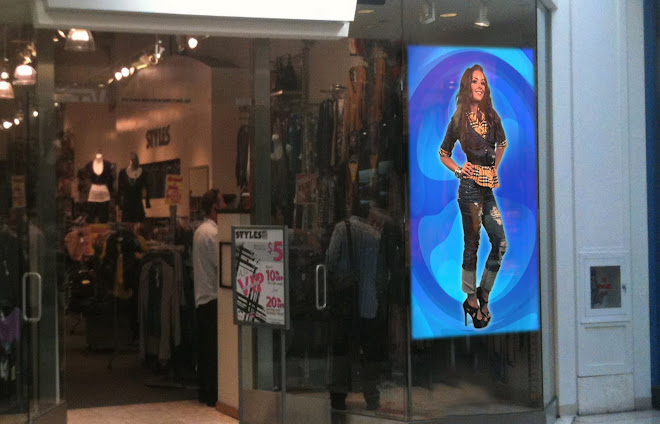
There's nothing better than a business marketing tool that works for you, even when you're not around. When the retail store closes, there is still traffic passing by that can and should be marketed to.
After hours, or night time, is prime time for using your storefront for marketing. Using a Window Video System (WVS) by Looknglas to animate and bring your storefront windows to life works BEST after dark. Better contrast, no competing with the internal store displays, reaching target audience even when the store is closed can make a huge difference. How about advertising tomorrow's sale? How about promoting your website or Social Media marketing site? How about inviting them to use their phone to download your mobile coupon? There are so many ways to use WVS after dark to continue to market and literally SELL your products.
What did Clapton say? "After midnight, we're gonna let it all hang out!" You've got the brick and mortar location and that window space---use it to make money!
Thursday, August 18, 2011


Friday, August 5, 2011
Revitalizing Retail
For the last three years, brick and mortar retailers have been up against it. With this ridiculous double-dipping economic recession, combined with increasing competition from online retailers, and consumers spending less, it has been tough, tough, tough.
Retail needs a shot in the arm.
Window Video Systems (WVS) in the form of Digital Windows and especially, Digital Mannequin, represent a watershed opportunity to put a lot of excitement back into the shopping experience.
"Live" models, directly on the glass, there one moment, gone the next, replaced with an in-the-moment sales promo message, offer, or text coupon offer.
WVS does, attraction, display, direct marketing, store hours, whatever type of message the retailer needs. The ability to change you message right on the front of your store, as many times as you wish, is here. Posters? Passe. LCD screens? Got a tv at home. Mannequins? Missed that.
But color, moving images right on the window glass? Awesome, intriquing, irresistable. When designers and retailers realize they can do a mini-fashion show right on the chains' storefront windows, all across the chain, it will revolutionize the mentality of display. Get ready for the fun, and get ready to start making more money. WVS by Looknglas: the Window of Opportunity is Here.
Retail needs a shot in the arm.
Window Video Systems (WVS) in the form of Digital Windows and especially, Digital Mannequin, represent a watershed opportunity to put a lot of excitement back into the shopping experience.
"Live" models, directly on the glass, there one moment, gone the next, replaced with an in-the-moment sales promo message, offer, or text coupon offer.
WVS does, attraction, display, direct marketing, store hours, whatever type of message the retailer needs. The ability to change you message right on the front of your store, as many times as you wish, is here. Posters? Passe. LCD screens? Got a tv at home. Mannequins? Missed that.
But color, moving images right on the window glass? Awesome, intriquing, irresistable. When designers and retailers realize they can do a mini-fashion show right on the chains' storefront windows, all across the chain, it will revolutionize the mentality of display. Get ready for the fun, and get ready to start making more money. WVS by Looknglas: the Window of Opportunity is Here.
Thursday, August 4, 2011
How Much Does IT Cost? (Part 2)
This is always one of the first questions. It's ok, it's a good question. Everybody wants to know that. But understanding the value behind the question is what should drive the discussion.
Having said that, (and assuaged my rational business mind, not wanting to be a guy who ignores the importance of creating, adding and promoting value,) I'm going to answer the question directly.
Sort of.
A Digital Window System (which is another way of saying WVS for storefront windows) with a screen size of 33"x44" runs $2,995.00 US. There, I said it. Now you can hopefully allow yourself to start asking the more important questions.
How will I use this? What type of messages will I run? How will I integrate this Digital Sign with my current marketing and Direct Advertising strategies? Can I integrate this into a local mobile strategy? Will I also use it for display? How to get/create images? Messages? These are the real issues. This system is an incredible marketing tool; think about all the ways you could use it to attract and engage and sell to customers. Then the price will start to make more sense. There is nothing more important than a business tool that directly helps you make money, and that is the purpose and mission of Window Video Systems by Looknglas.
Having said that, (and assuaged my rational business mind, not wanting to be a guy who ignores the importance of creating, adding and promoting value,) I'm going to answer the question directly.
Sort of.
A Digital Window System (which is another way of saying WVS for storefront windows) with a screen size of 33"x44" runs $2,995.00 US. There, I said it. Now you can hopefully allow yourself to start asking the more important questions.
How will I use this? What type of messages will I run? How will I integrate this Digital Sign with my current marketing and Direct Advertising strategies? Can I integrate this into a local mobile strategy? Will I also use it for display? How to get/create images? Messages? These are the real issues. This system is an incredible marketing tool; think about all the ways you could use it to attract and engage and sell to customers. Then the price will start to make more sense. There is nothing more important than a business tool that directly helps you make money, and that is the purpose and mission of Window Video Systems by Looknglas.
Driving the Dealership: Pre-conditioned Customers
Car buyers are more informed these days. Everybody knows that. But informed is not necessarily "warmed". You need buyers on the lot who are not just interested, but "hot" for the product. Motivated. Want what you have. So how do you get from "informed" to "Hot to buy"?
Auto brands invest a great deal in that proposition. Most TV ads are aimed at that very effect. The goal of making your brand and product attractive and desirable is a huge part of the Auto Industry's marketing efforts. And the dealership site, look, and ambience is one of the last links in that marketing chain that leads to the sale. Best, for your salespeople, to have warm, preconditioned, positive prospective customers on the lot than suspicious, defensive, belligerent ones.
So the Window Video System (WVS) by Looknglas is a strong way to do that. Here's a real world example: We have a Toyota dealership that uses WVS. The first thing they did was park a new model vehicle below the Digital Window (WVS) that was showing a Toyota "walk through" video of that new model. So every customer that approached the front door of that dealership not only saw the new model in front, but was drawn into the potential ownership experience by that Digital Window display directly above the vehicle. Customers were already taking a tour of the vehicle, its interior, features, and benefits before they ever spoke to the salesperson! They were already in the "sales" process! Awesome! Brilliant. And from a marketing perspective, essential.
The salesperson, consequently, was able to be speaking with an informed and involved customer; a very key distinction. Any salesman with any experience knows the immense value of a prospective customer who is already mentally "trying on" your product. You are way down the road to the close at that point.
WVS will warm up the selling environment in the dealership space. When you add to that, the ability to message Direct selling promos and messages, at the point of purchase, you create for your dealership and sales staff, much better selling and closing opportunities. That goes directly to ROI! Point of purchase Direct Marketing is one of the very best uses for Window Video Systems.
The Window of Opportunity is here.
Auto brands invest a great deal in that proposition. Most TV ads are aimed at that very effect. The goal of making your brand and product attractive and desirable is a huge part of the Auto Industry's marketing efforts. And the dealership site, look, and ambience is one of the last links in that marketing chain that leads to the sale. Best, for your salespeople, to have warm, preconditioned, positive prospective customers on the lot than suspicious, defensive, belligerent ones.
So the Window Video System (WVS) by Looknglas is a strong way to do that. Here's a real world example: We have a Toyota dealership that uses WVS. The first thing they did was park a new model vehicle below the Digital Window (WVS) that was showing a Toyota "walk through" video of that new model. So every customer that approached the front door of that dealership not only saw the new model in front, but was drawn into the potential ownership experience by that Digital Window display directly above the vehicle. Customers were already taking a tour of the vehicle, its interior, features, and benefits before they ever spoke to the salesperson! They were already in the "sales" process! Awesome! Brilliant. And from a marketing perspective, essential.
The salesperson, consequently, was able to be speaking with an informed and involved customer; a very key distinction. Any salesman with any experience knows the immense value of a prospective customer who is already mentally "trying on" your product. You are way down the road to the close at that point.
WVS will warm up the selling environment in the dealership space. When you add to that, the ability to message Direct selling promos and messages, at the point of purchase, you create for your dealership and sales staff, much better selling and closing opportunities. That goes directly to ROI! Point of purchase Direct Marketing is one of the very best uses for Window Video Systems.
The Window of Opportunity is here.
Tuesday, July 26, 2011
Retail Display - Looking Through You 2
Sometimes I get so caught up in my brilliant thoughts that I omit some real important, real basic things.
This is one of those times.
In retail display it's important to remember why stores have windows; it's so people can see in, see display, see product. So, drafting off my last post, holographic Window Video Systems allow you to add signage, messaging and display in your window without necessarily sacrificing the purpose of the window itself; that is, to see through and get a sense for what's inside. Herein is part of the excitement of WVS: Messaging in "thin air". The passerby (potential customer) sees the window display, and then sees a message appear, and then disappear or change. Wow! Now you got their attention. Now's the time to sell them with your best sale item, promotion, USP.
Holographic store window displays: Caught you looking!
This is one of those times.
In retail display it's important to remember why stores have windows; it's so people can see in, see display, see product. So, drafting off my last post, holographic Window Video Systems allow you to add signage, messaging and display in your window without necessarily sacrificing the purpose of the window itself; that is, to see through and get a sense for what's inside. Herein is part of the excitement of WVS: Messaging in "thin air". The passerby (potential customer) sees the window display, and then sees a message appear, and then disappear or change. Wow! Now you got their attention. Now's the time to sell them with your best sale item, promotion, USP.
Holographic store window displays: Caught you looking!
Wednesday, May 11, 2011
Retail Display - Looking Through You
"I'm looking through you..." so went the chorus line of a Beatles song. And it definitely applies in terms of the effect one is after when implementing a rear projection in the retail space.
Retail display is all about attraction, intrigue, hipness, enticement. It has to make you want the product. It has to promise more if you'll just come in the store.
That is why rear projection, and in particular, window video systems, are such a great starting point, and such a potentially powerful display tool. But once you decide it would be cool to have a moving image directly on your storefront window, then what? Do you need to have a solid, high-contrast image? Or would it be better to actually be able to see through the image?
Allowing for a digital image directly on the window glass, in essence, a digital window sign that can be seen through, could be the exact effect necessary, where there is a combination of actual product displayed, combined with the Digital Window effect.
Holographic means you have a sort of "ghostly", or see-through effect to the image. Granted, you lose some density with this approach, and you lose some viewing angle, but you gain a very distinct, subtle and surprising effect of having "animated" window glass.
This is markedly different from a more dense, high-contrast images requiring high-contrast window treatment that renders the glass opaque (usually charcoal gray.)
Holographics = surprise, intrigue and coolness. It's the "whoa, how'd they do that!!!" effect. And that can be a very powerful ally in point of purchase display. Now you've got them looking.
Retail display is all about attraction, intrigue, hipness, enticement. It has to make you want the product. It has to promise more if you'll just come in the store.
That is why rear projection, and in particular, window video systems, are such a great starting point, and such a potentially powerful display tool. But once you decide it would be cool to have a moving image directly on your storefront window, then what? Do you need to have a solid, high-contrast image? Or would it be better to actually be able to see through the image?
Allowing for a digital image directly on the window glass, in essence, a digital window sign that can be seen through, could be the exact effect necessary, where there is a combination of actual product displayed, combined with the Digital Window effect.
Holographic means you have a sort of "ghostly", or see-through effect to the image. Granted, you lose some density with this approach, and you lose some viewing angle, but you gain a very distinct, subtle and surprising effect of having "animated" window glass.
This is markedly different from a more dense, high-contrast images requiring high-contrast window treatment that renders the glass opaque (usually charcoal gray.)
Holographics = surprise, intrigue and coolness. It's the "whoa, how'd they do that!!!" effect. And that can be a very powerful ally in point of purchase display. Now you've got them looking.
Monday, May 2, 2011
Integration: Mix and Match, Or...?
I've been getting questions about whether Looknglas systems can integrate with other systems or components.
Some have already invested in components, a screen here or there, and Digital control system, software or player. The question is basically coming from the standpoint, will this piece of hardware work with that one, or will this software control system work with those projection systems?
I guess the answer is, uhh, maybe.
The reality is that there are a great many components and software/hardware platforms out there. Digital Signage is a big fat generality. Theoretically, a lot of the stuff out there will work with a lot of the other stuff. You can't really know for certain about how anything works for or with anything else in a certain environment, for a given purpose, (with whatever content and look you envision,) until you evaluate and test. Assembling a Digital Signage or Display system isn't all that simple, because it's not just a gathering of technology hardware. Like with all serious business investments, a properly implemented system is a matter of goals and objectives, tailored specifically to the clients wants, needs and operating environment.
Digital Signage is really about your message, or how you want to communicate (talk) to your target audience. So you want to talk to them? Let's talk.
Some have already invested in components, a screen here or there, and Digital control system, software or player. The question is basically coming from the standpoint, will this piece of hardware work with that one, or will this software control system work with those projection systems?
I guess the answer is, uhh, maybe.
The reality is that there are a great many components and software/hardware platforms out there. Digital Signage is a big fat generality. Theoretically, a lot of the stuff out there will work with a lot of the other stuff. You can't really know for certain about how anything works for or with anything else in a certain environment, for a given purpose, (with whatever content and look you envision,) until you evaluate and test. Assembling a Digital Signage or Display system isn't all that simple, because it's not just a gathering of technology hardware. Like with all serious business investments, a properly implemented system is a matter of goals and objectives, tailored specifically to the clients wants, needs and operating environment.
Digital Signage is really about your message, or how you want to communicate (talk) to your target audience. So you want to talk to them? Let's talk.
Subscribe to:
Posts (Atom)
