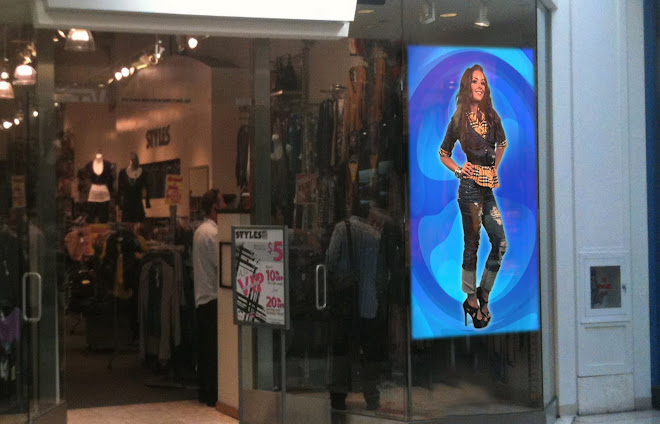
I know this has been addressed before by other of my fellow curmudgeons keeping an eye on the doings in DOOH. Yet the issue remains:
More than one message per screen diminishes the effectiveness of the whole. The infamous "L". A main screen, with a column on the right or left side, accompanied by a lower banner across the entire bottom of the screen, often with a data stream.
Two words: TOO BUSY!
I know this will not stop anyone from using this screen configuration. I know it will not stop the average ad salesperson from trying to sell all those different screen opportunities. But people, please, listen: as a visual layout, this absolutely blows!
The next time you see a digital screen in the marketplace, if it has this layout, I want you to consciously try to notice whether your own eye finds it easy to take in all the messages, images and data that this format presents. I already know the answer.
I totally agree that all of the small screen should be utilized; just not in this manner. This is a content creation issue. This is an issue of actually thinking about your viewer, and caring about whether they will care. Your content better be interesting and relevant. It better grab their attention and deliver the "goods" (message) in a meaningful, useful way, or you risk committing the deadly sin of diminishing (or even completely immasculating) your own medium.
Focus on the want/need/interest/preference of your target viewer. Spend some serious time and money on your content development. You might make a little money this month with a poor ad campaign on behalf of your clients, but not next month. If it does not work, they will not continue to buy. If your network does not produce the desired effect (usually some measurable business-related result) your clients will stop buying and go elsewhere. There are too many opportunities and options available to their ad dollar.
There may (on rare occasions) be legitimate times to utilize a split screen, but I can't think of what they are off-hand. Don't divide your screen (message). Better to shorten your ad units and ad more inventory, than to have multiple disparate messages on one screen at the same time.
Showing posts with label graphic display. Show all posts
Showing posts with label graphic display. Show all posts
Monday, December 17, 2012


Tuesday, April 17, 2012
A Bright Idea - Light diffusion
A very common problem with digital signage window displays is reflectivity of the window glass, particularly in outdoor environments with direct sunlight.
The issue is twofold: First, your signage is not, and will never be, brighter than the sun. Second, the surface of the window is reflective, picking up every primary, as well as secondary (or reflective) light source which ultimately wreaks havoc with your window display.
One possible solution is installing anti-reflective film on the exterior surface of the window. Light diffusive film can be an ally in making your display pop better to passing viewers.
Another solution is LED signage, which is very effective (at distance) but with pixels more obvious at close up range.
We are interested in your thoughts on solutions for the ongoing battle with the sun. What have your results been?
The issue is twofold: First, your signage is not, and will never be, brighter than the sun. Second, the surface of the window is reflective, picking up every primary, as well as secondary (or reflective) light source which ultimately wreaks havoc with your window display.
One possible solution is installing anti-reflective film on the exterior surface of the window. Light diffusive film can be an ally in making your display pop better to passing viewers.
Another solution is LED signage, which is very effective (at distance) but with pixels more obvious at close up range.
We are interested in your thoughts on solutions for the ongoing battle with the sun. What have your results been?
Monday, November 7, 2011
Where's the DR in DS?
D'Oh!!!
Someone forgot to put an "R" in "DS" or "DOOH"!
"R" as in "RESPONSE". We all know that the purpose of DOOH is to communicate more effectively to target audiences where they are---out in the marketplace. Lots of attention has been paid to "communicate", but more attention could be paid to "effectively". Doing that requires a focus on measurable campaigns, calls to action, and selling proposition. DOOH is a fantastic media, but it will become more and more dominant as the numbers come in on effectiveness. And focusing on measurable response provides you the numbers and justification for your selling efforts.
Make sure that when you pitch your solution you recommend Direct campaigns, along with all the other wonderful things your solution can do. It is the key to selling non-marketing-oriented decision makers. Return on investment is a critical component to good business decision making, so be sure to at least have some hypothetical examples of return on investment for your target client.
For example, if you have an automotive dealership client who makes $600 per sale of their mid-range model, then give him an example of a campaign designed to sell mid-range models and how many it will take to pay for your system and show profitability. Seems obvious, I know, but people tend to get excited about the technology, and sometimes forget to build some strong ROI-based financial justification into the sale. Equally important, once the sale is made, work hard to get the client to use their DOOH for Direct Selling or Direct Response campaigns, where they can measure effectiveness. If you don't produce marketing content for your solution, hook up with a quality marketing-savvy content provider, and offer that service. It will build value, profitability for you, and a more satisfied, long-term client. And if you need a referral for content, give me a shout.
Someone forgot to put an "R" in "DS" or "DOOH"!
"R" as in "RESPONSE". We all know that the purpose of DOOH is to communicate more effectively to target audiences where they are---out in the marketplace. Lots of attention has been paid to "communicate", but more attention could be paid to "effectively". Doing that requires a focus on measurable campaigns, calls to action, and selling proposition. DOOH is a fantastic media, but it will become more and more dominant as the numbers come in on effectiveness. And focusing on measurable response provides you the numbers and justification for your selling efforts.
Make sure that when you pitch your solution you recommend Direct campaigns, along with all the other wonderful things your solution can do. It is the key to selling non-marketing-oriented decision makers. Return on investment is a critical component to good business decision making, so be sure to at least have some hypothetical examples of return on investment for your target client.
For example, if you have an automotive dealership client who makes $600 per sale of their mid-range model, then give him an example of a campaign designed to sell mid-range models and how many it will take to pay for your system and show profitability. Seems obvious, I know, but people tend to get excited about the technology, and sometimes forget to build some strong ROI-based financial justification into the sale. Equally important, once the sale is made, work hard to get the client to use their DOOH for Direct Selling or Direct Response campaigns, where they can measure effectiveness. If you don't produce marketing content for your solution, hook up with a quality marketing-savvy content provider, and offer that service. It will build value, profitability for you, and a more satisfied, long-term client. And if you need a referral for content, give me a shout.
Wednesday, October 12, 2011
Commercials on Your Storefront Window 2
In the above video showing a window video system displaying in a retail store, the images are varied, high impact, eye-catching, and brand-centric. They create intrigue, they promote specific product, they display. In particular, notice the close up shots of the window videos towards the end of this video sample.
If you're going to run "commercials" on your storefront window, what will that message be? Will it feature product shots? Will it feature models interacting with the product? Do you intend to incorporate audio, or visual only? Still shots, or full motion video? Type messages? Graphics? CG Animation?
What will the purpose of your commercial be? Display? Information, usage?
Putting together a successful commercial for your window videos should take some planning and attention to production values and quality execution. Simple type-based messages, graphics and still shots may be a good way to start. More sophisticated motion images using models, lighting, etc. will require more expertise and budget.
The better the effect of the imagery, the better the potential effect on creating traffic and sales. Think about how you can use video, type, still photos and graphics to better attract customers, and give them a reason to come into your store.
Window Video Systems put the power of messaging that used to belong only to the largest corporations, directly in your hands, and directly on your storefront. At Looknglas, we provide all of the above for you so that you don't have to be a graphics or video expert to have a really exciting window commercial. The window of opportunity is here.
If you're going to run "commercials" on your storefront window, what will that message be? Will it feature product shots? Will it feature models interacting with the product? Do you intend to incorporate audio, or visual only? Still shots, or full motion video? Type messages? Graphics? CG Animation?
What will the purpose of your commercial be? Display? Information, usage?
Putting together a successful commercial for your window videos should take some planning and attention to production values and quality execution. Simple type-based messages, graphics and still shots may be a good way to start. More sophisticated motion images using models, lighting, etc. will require more expertise and budget.
The better the effect of the imagery, the better the potential effect on creating traffic and sales. Think about how you can use video, type, still photos and graphics to better attract customers, and give them a reason to come into your store.
Window Video Systems put the power of messaging that used to belong only to the largest corporations, directly in your hands, and directly on your storefront. At Looknglas, we provide all of the above for you so that you don't have to be a graphics or video expert to have a really exciting window commercial. The window of opportunity is here.
Tuesday, October 11, 2011
How Important is "Easy" Content?
Everybody likes great-looking content. It's fun, interesting, adds a little spice to life and to the experience.
Management loves effective content. Prove-able ROI is a powerful thing. Just knowing your message is producing sales is a wonderful feeling for a small business owner or company manager.
When you get great-looking and effective in the same package, it's approaching Digital Signage Messaging Nirvana. But the next level of Nirvana might be, "Easy to Use".
That sounds nice, but tough to attain, alongside the first two. So, I've got a question: How important is Easy to Use?
As a retailer thinking about using projected Digital Signage (Window Video Systems) on your storefront, if you were to purchase such a system:
Would you want to create your own messages?
Produce your own images?
Would you want a selection of images from which you could choose?
Or would you want someone else to do that for you?
What is your "ideal" Signage Message "method"? Do-it-yourself, or have the professionals handle it? Please comment. Thanks!
Management loves effective content. Prove-able ROI is a powerful thing. Just knowing your message is producing sales is a wonderful feeling for a small business owner or company manager.
When you get great-looking and effective in the same package, it's approaching Digital Signage Messaging Nirvana. But the next level of Nirvana might be, "Easy to Use".
That sounds nice, but tough to attain, alongside the first two. So, I've got a question: How important is Easy to Use?
As a retailer thinking about using projected Digital Signage (Window Video Systems) on your storefront, if you were to purchase such a system:
Would you want to create your own messages?
Produce your own images?
Would you want a selection of images from which you could choose?
Or would you want someone else to do that for you?
What is your "ideal" Signage Message "method"? Do-it-yourself, or have the professionals handle it? Please comment. Thanks!
Friday, October 7, 2011
Good Job, Jobs
The world acknowledges and mourns the passing of one of the most influential human beings (in terms of business, communications, entertainment and productivity) in history: Steve Jobs.
Much has been said about this remarkable man and his many accomplishments. Many revere him and some revile him, but the fact remains that he transformed the way the entire world works. His demand that technology be nice to look at, easy to use, and bottom-shelf in terms of accessibility (ok, well perhaps not always in terms of pricing) and elegant, set a standard for his own industry and many others.
 He is lauded for his impact on computing, and particularly personal productivity and entertainment, but not enough credit is given for the sheer breadth of his impact: the man transformed (and in some cases, co-opted) the music, movie and cellphone industries, and boosted productivity in many others. And he was likely in the process of doing the same once again for tv. Under his leadership, Apple was transformed into one of the largest businesses in the history of the world.
Absolutely incredible. Farewell, Steve, we'll miss your impact.
Much has been said about this remarkable man and his many accomplishments. Many revere him and some revile him, but the fact remains that he transformed the way the entire world works. His demand that technology be nice to look at, easy to use, and bottom-shelf in terms of accessibility (ok, well perhaps not always in terms of pricing) and elegant, set a standard for his own industry and many others.
Absolutely incredible. Farewell, Steve, we'll miss your impact.
Thursday, August 4, 2011
How Much Does IT Cost? (Part 2)
This is always one of the first questions. It's ok, it's a good question. Everybody wants to know that. But understanding the value behind the question is what should drive the discussion.
Having said that, (and assuaged my rational business mind, not wanting to be a guy who ignores the importance of creating, adding and promoting value,) I'm going to answer the question directly.
Sort of.
A Digital Window System (which is another way of saying WVS for storefront windows) with a screen size of 33"x44" runs $2,995.00 US. There, I said it. Now you can hopefully allow yourself to start asking the more important questions.
How will I use this? What type of messages will I run? How will I integrate this Digital Sign with my current marketing and Direct Advertising strategies? Can I integrate this into a local mobile strategy? Will I also use it for display? How to get/create images? Messages? These are the real issues. This system is an incredible marketing tool; think about all the ways you could use it to attract and engage and sell to customers. Then the price will start to make more sense. There is nothing more important than a business tool that directly helps you make money, and that is the purpose and mission of Window Video Systems by Looknglas.
Having said that, (and assuaged my rational business mind, not wanting to be a guy who ignores the importance of creating, adding and promoting value,) I'm going to answer the question directly.
Sort of.
A Digital Window System (which is another way of saying WVS for storefront windows) with a screen size of 33"x44" runs $2,995.00 US. There, I said it. Now you can hopefully allow yourself to start asking the more important questions.
How will I use this? What type of messages will I run? How will I integrate this Digital Sign with my current marketing and Direct Advertising strategies? Can I integrate this into a local mobile strategy? Will I also use it for display? How to get/create images? Messages? These are the real issues. This system is an incredible marketing tool; think about all the ways you could use it to attract and engage and sell to customers. Then the price will start to make more sense. There is nothing more important than a business tool that directly helps you make money, and that is the purpose and mission of Window Video Systems by Looknglas.
Tuesday, April 26, 2011
Driving the Dealership: Customer Experience
Auto Dealers are a real mixed bag. A walk around the dealership lot, showroom, and customer lounge will give you a pretty quick idea of their perspective on selling cars. The perspectives could be summed up as the two poles:
A. Who gives a crap? We'll shove our cars on you and squeeze you for as much as we can.
B. You are a valued customer who we feel privileged to serve, and we'd like you to come back and bring your family and friends.
Most dealers are somewhere between those two poles, but all the best dealers are closer to the second perspective. Customer service, and Customer Satisfaction are paramount to these auto professionals, and Customer Experience is an integral part of both.
You can't overemphasize the value of (good) Customer Experience. It begins with the very first contact and impression that your dealership makes on the customer. And continues throughout the process.
Window Video Systems by Looknglas, are an integral part of creating an exciting and reassuring experience for your customer, which increases the liklihood of a purchase, and cements the sale. Your brand produces so much content, and so much of it goes unnoticed, or worse, never even viewed. That is because the delivery systems are not adequate to the quantity and quality of those graphic messages. Still shots, type messages, and video, are all produced in abundance by the brands, but often poorly displayed at the dealership.
Window Video Systems put those images and messages right on the Windows of your dealership or showroom! Digital Windows displaying the same quality images the customer saw online, or in their favorite publication, the same selling propositions, create a continuity and credibility of the messages. That is, "Oh it really is true." That is enormous in securing the sale and the ongoing business of that customer. If they believe (in) you, they will do business, refer business, and come back for more.
Digital Posters, Digital Windows, even Digital Mannequins as initial sales greeters or presenters, will all create an impression of progressiveness, quality, intrigue, and excitement. And that's what you want in a customer, excitement, and anticipation. Window Video Systems may be the ultimate enhancement to the customer experience.
A. Who gives a crap? We'll shove our cars on you and squeeze you for as much as we can.
B. You are a valued customer who we feel privileged to serve, and we'd like you to come back and bring your family and friends.
Most dealers are somewhere between those two poles, but all the best dealers are closer to the second perspective. Customer service, and Customer Satisfaction are paramount to these auto professionals, and Customer Experience is an integral part of both.
You can't overemphasize the value of (good) Customer Experience. It begins with the very first contact and impression that your dealership makes on the customer. And continues throughout the process.
Window Video Systems by Looknglas, are an integral part of creating an exciting and reassuring experience for your customer, which increases the liklihood of a purchase, and cements the sale. Your brand produces so much content, and so much of it goes unnoticed, or worse, never even viewed. That is because the delivery systems are not adequate to the quantity and quality of those graphic messages. Still shots, type messages, and video, are all produced in abundance by the brands, but often poorly displayed at the dealership.
Window Video Systems put those images and messages right on the Windows of your dealership or showroom! Digital Windows displaying the same quality images the customer saw online, or in their favorite publication, the same selling propositions, create a continuity and credibility of the messages. That is, "Oh it really is true." That is enormous in securing the sale and the ongoing business of that customer. If they believe (in) you, they will do business, refer business, and come back for more.
Digital Posters, Digital Windows, even Digital Mannequins as initial sales greeters or presenters, will all create an impression of progressiveness, quality, intrigue, and excitement. And that's what you want in a customer, excitement, and anticipation. Window Video Systems may be the ultimate enhancement to the customer experience.
Thursday, February 17, 2011
Selling WVS: Know Your Market, Know Your Strengths
We have get inquiries from all over the world about our Window Video Systems: Digital Mannequin, Digital Windows, Digital Banners. Everybody loves WVS. Some think it's alchemy; some think anyone can do it. Some think the world will beat a path to their door if they can just secure the rights to market our proprietary systems in their country, region or niche.
WVS will transform messaging and display in the retail space in particular, but other venues as well. But understanding the strengths and limitations of WVS, where it works well and where it won't is essential to making money with WVS.
Remember, it's hardware, content, proper installation, and method. It's knowing the value and potential for Return on Investment that wins the game and makes money.
Launching a new media is not for the weak of heart.
Everybody likes what they see, but not many really understand exactly how it will benefit them, and when you are selling WVS, it's up to you to demonstrate that. Fortunately, the data on how Digital Signage affects sales, is starting to come in. Walmart reported across the board increases in all segments of their lines. And I don't even think they are as effective in their method as they could be (like not incorporating WVS!) It isn't hard to imagine how better display and motion-enhanced, changing sales and promo messages can have a huge impact on the selling/buying environment in retail.
So before you contact us, know your market, your segment, and how you plan to use WVS to make a profit for your clients. There is more to the potential than just a hardware sale.
WVS will transform messaging and display in the retail space in particular, but other venues as well. But understanding the strengths and limitations of WVS, where it works well and where it won't is essential to making money with WVS.
Remember, it's hardware, content, proper installation, and method. It's knowing the value and potential for Return on Investment that wins the game and makes money.
Launching a new media is not for the weak of heart.
Everybody likes what they see, but not many really understand exactly how it will benefit them, and when you are selling WVS, it's up to you to demonstrate that. Fortunately, the data on how Digital Signage affects sales, is starting to come in. Walmart reported across the board increases in all segments of their lines. And I don't even think they are as effective in their method as they could be (like not incorporating WVS!) It isn't hard to imagine how better display and motion-enhanced, changing sales and promo messages can have a huge impact on the selling/buying environment in retail.
So before you contact us, know your market, your segment, and how you plan to use WVS to make a profit for your clients. There is more to the potential than just a hardware sale.
Wednesday, November 10, 2010
Image + Effect = Winning Message
The hardware is the easy part of Digital Signage, even when it comes to Projected Digital Signage by Looknglas.
The really important part is what you do with that cool hardware. With commercial Advertising or Point of Purchase (POP) messaging, it is so important to use that Digital screen, whether LCD or Digital Window, to the maximum effect. That means large size, but also, changing messages, looks, and especially, effects.
Effects are what you do with the graphic to make it interesting: Color, size, font, background, still images or motion video, movement, fading in or out, or any visual change or metamorphosis of the afore mentioned elements.
No one pays much attention to static signs; you perceive them in a moment and quickly discard them before even consciously taking note, in most cases. Using visual effects properly will not only give you attraction, but also "sticking". That is, retention, repeat viewing, or best of all, response to a good selling proposition.
Using effects properly also means not overdoing it. Constantly trying to out-entertain your competitors is a losing proposition. The presentation that gets them to look, consider, and respond is the most effective. Be careful not to get carried away with effects, but rather use them to mix up the look, as well as creating intrigue. The bottom line is to sell the viewer on whatever your proposition is. Don't go overboard with the creativity or the hunt for interactivity. Use effects to make a powerful selling proposition to your target, and they will notice and respond.
The really important part is what you do with that cool hardware. With commercial Advertising or Point of Purchase (POP) messaging, it is so important to use that Digital screen, whether LCD or Digital Window, to the maximum effect. That means large size, but also, changing messages, looks, and especially, effects.
Effects are what you do with the graphic to make it interesting: Color, size, font, background, still images or motion video, movement, fading in or out, or any visual change or metamorphosis of the afore mentioned elements.
No one pays much attention to static signs; you perceive them in a moment and quickly discard them before even consciously taking note, in most cases. Using visual effects properly will not only give you attraction, but also "sticking". That is, retention, repeat viewing, or best of all, response to a good selling proposition.
Using effects properly also means not overdoing it. Constantly trying to out-entertain your competitors is a losing proposition. The presentation that gets them to look, consider, and respond is the most effective. Be careful not to get carried away with effects, but rather use them to mix up the look, as well as creating intrigue. The bottom line is to sell the viewer on whatever your proposition is. Don't go overboard with the creativity or the hunt for interactivity. Use effects to make a powerful selling proposition to your target, and they will notice and respond.
Wednesday, August 25, 2010
iPhone, iPod, and the Window Video System Display
Shortly after I launched into projected Digital Signage, or Window Video Systems (WVS), I realized I needed to create a demonstration method for WVS that was portable and fast to set up. So I created this product which is now a kit that we sell for showing a Video Demonstration using rear projection.
I didn't realize I was creating a product at the time, but since then, it dawned on me how superior a larger screen for showing video or still graphics is, to say, showing your client or prospect your graphic on a computer screen. Many images just scream out for size, and the computer screen often just doesn't do justice. So the next best thing might be to run the image to a TV, or use the large conference room projector, but that is often such a hassle.
Well now, you can leverage your iPhone (that ultimate business tool) or iPod, or now, your Android phone to do Video presentations. Here is the marketing video we put together for the 2-foot Video Display screen for the iPhone.
Intrigue and Attraction are 2 of the most powerful elements of any presentation or display. This video illustrates how even in a presentation-style display, the intrigue of rear-projected images take your images from commonplace to "WOW". And it runs on an iPhone or iPod??? That's nuts! But it's really fun and potentially very powerful for more effectively conveying a sales message, or any other type of video or still graphic presentation.
This is just a small demonstrator version of the larger window video systems we are pioneering, some of which you've seen on our website or Youtube. Interested to know your thoughts.
I didn't realize I was creating a product at the time, but since then, it dawned on me how superior a larger screen for showing video or still graphics is, to say, showing your client or prospect your graphic on a computer screen. Many images just scream out for size, and the computer screen often just doesn't do justice. So the next best thing might be to run the image to a TV, or use the large conference room projector, but that is often such a hassle.
Well now, you can leverage your iPhone (that ultimate business tool) or iPod, or now, your Android phone to do Video presentations. Here is the marketing video we put together for the 2-foot Video Display screen for the iPhone.
Intrigue and Attraction are 2 of the most powerful elements of any presentation or display. This video illustrates how even in a presentation-style display, the intrigue of rear-projected images take your images from commonplace to "WOW". And it runs on an iPhone or iPod??? That's nuts! But it's really fun and potentially very powerful for more effectively conveying a sales message, or any other type of video or still graphic presentation.
This is just a small demonstrator version of the larger window video systems we are pioneering, some of which you've seen on our website or Youtube. Interested to know your thoughts.
Subscribe to:
Posts (Atom)
