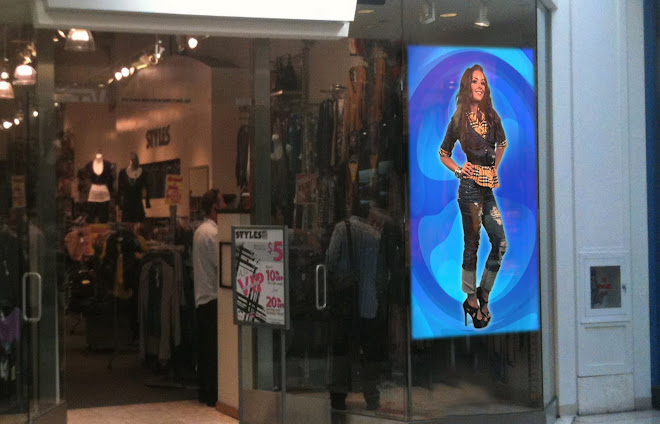
Customer experience, featuring interactivity (most commonly touch) is the coming thing in the retail industry. And rightly so.
Brick and mortar retail has the advantage over online retail in that they can provide a superior experience. After all, online can only provide so much, and all of it "virtual". But brick and mortar can provide "real" and people are hungering for ever more "real" experiences. Actual engaging interaction at the Point Of Sale (POS) is a huge distinction and advantage that the brick and mortar store can offer. Apple stores, Microsoft stores, AT&T's new interactive store, and even places like Cabela's and Bass Pro Shops are all great examples of retail POS engagement. The places that do it really well are destinations. You love going there. They keep it real and relevant.
Digital Signage can assist greatly in this POS engagement. Text campaigns, QR campaigns, Social Media campaigns, even simple signage promo campaigns that drive the viewer to interact in some distinct way with the store, its product or its personnel are all strategies that need to be employed via digital signage. Please don't stop with mere signage messaging; get that powerful DS or DOOH system working to engage people, especially customers, to add value, to enhance that vital (personal) business relationship. Every personal interaction you create enhances the relationship in so much more powerful a way than a "like" or a share.
You have the tools; step out of the box, figuratively and literally. Work on new ways to use your DS, especially Window Video Systems, to engage!
Thursday, August 30, 2012


Friday, August 10, 2012
Ahead of the Game
Some ideas are just a wee bit ahead of their time. If you're a techno-geek/gadget fan, if you scour Mashable daily for cool new technology breakthroughs and products, if you're always looking for the next new cool thing, then you already know this: Technology always far outstrips the marketplace's willingness or ability to adopt. That may never have been truer than today, with a worldwide recession keeping a damper on things, at the same time as unprecedented tech advances continue to come around the bend.
This blog being about DOOH generally, and Window Video Systems (projected digital signage) in particular, I am pleased to announce that the reasons why WVS has not caught on faster in the retail space are starting to disappear. Sheer unfamiliarity is the least of these, and the proliferation of screens of all types being used for display has blown that one away. But for WVS, one big problem has been cost of ownership (projectors aren't cheap, and they're not cheap to maintain when you want to run them 24/7 or even daily.)
A constant stream of upgrading projectors is addressing this, with smaller and smaller projectors getting brighter and brighter. Costs are likewise coming down. Most importantly, new projection lamp technologies are directly affecting the issue of lamp life and/or lamp replacement, for the better.
Another issue has been a general lack of expertise in terms of creation, deployment and management of content for WVS systems designed for retail use. This is also an area where costs have been somewhat prohibitive for higher-effect content look and execution. I can happily report that Looknglas is bringing increasing expertise and flair to the content creation and management issue. Better method, as well as efficiencies are on the way.
What this means is, Window Video Systems for retail are more easily available in terms of cost, price and content creation/management than ever before, by a significant increment. Bottom shelf pricing of systems, attainable by even the humblest retailers, will be a welcome development for the retail sector, and should contribute to a continuing transformation of retail display, messaging, and customer experience.
This blog being about DOOH generally, and Window Video Systems (projected digital signage) in particular, I am pleased to announce that the reasons why WVS has not caught on faster in the retail space are starting to disappear. Sheer unfamiliarity is the least of these, and the proliferation of screens of all types being used for display has blown that one away. But for WVS, one big problem has been cost of ownership (projectors aren't cheap, and they're not cheap to maintain when you want to run them 24/7 or even daily.)
A constant stream of upgrading projectors is addressing this, with smaller and smaller projectors getting brighter and brighter. Costs are likewise coming down. Most importantly, new projection lamp technologies are directly affecting the issue of lamp life and/or lamp replacement, for the better.
Another issue has been a general lack of expertise in terms of creation, deployment and management of content for WVS systems designed for retail use. This is also an area where costs have been somewhat prohibitive for higher-effect content look and execution. I can happily report that Looknglas is bringing increasing expertise and flair to the content creation and management issue. Better method, as well as efficiencies are on the way.
What this means is, Window Video Systems for retail are more easily available in terms of cost, price and content creation/management than ever before, by a significant increment. Bottom shelf pricing of systems, attainable by even the humblest retailers, will be a welcome development for the retail sector, and should contribute to a continuing transformation of retail display, messaging, and customer experience.
Wednesday, June 27, 2012
The "I" effect on Digital Signage
I love my iPhone. Ipad owners love their iPads. Ipod users love their iPods.
You know why that is? Because they're great products: they're well-designed and they work great and do more than you really need them to, but it's great just knowing they can do all that cool stuff.
Digital Signage and Digital Out of Home devices have only partial coolness. The technology is usually pretty good, but content and ease of use, as well as method, are hit and miss.
That is the great burden which we must bear and find ways to ease: we live in a generation that is conditioned to unbelievably great products like what Apple has produced and ubiquitously popularized, so everything and everyone else has to try to measure up. This is a heavy burden indeed.
With DS and DOOH there are very very few places you can go to receive the type of integrated great end result for purposes like retail, at a cost effective price. The hardware company wants to sell their components, the SaaS or Signage management company wants to sell you their system, the integrator wants to tell you they can put it all together for you, and the content provider wants sell you on their content capabilities. Imagine if iPhones were sold that way.
You'll argue that apps have to be sold or downloaded separately. True, but the devices themselves come with so many useful apps and valuable capability, and then the downloading of free apps is so easy, that DS and DOOH pale by comparison. It is not a end-user-friendly proposition, especially for retailers.
But that is what it needs to be. Discovering the right level of user tolerance and acceptance/ease-of-use is the task.
I put it to you retail merchandisers: What would you expect to pay for a Digital Signage solution that was easy for you to use on a daily basis in your store window? More specifically, what would you expect to pay for a window video system, like a Digital Mannequin, such as the one shown here:
Or such as the one depicted here in the Oakley store:
I would be interested in all your thoughts on pricing such systems. Let me know!
You know why that is? Because they're great products: they're well-designed and they work great and do more than you really need them to, but it's great just knowing they can do all that cool stuff.
Digital Signage and Digital Out of Home devices have only partial coolness. The technology is usually pretty good, but content and ease of use, as well as method, are hit and miss.
That is the great burden which we must bear and find ways to ease: we live in a generation that is conditioned to unbelievably great products like what Apple has produced and ubiquitously popularized, so everything and everyone else has to try to measure up. This is a heavy burden indeed.
With DS and DOOH there are very very few places you can go to receive the type of integrated great end result for purposes like retail, at a cost effective price. The hardware company wants to sell their components, the SaaS or Signage management company wants to sell you their system, the integrator wants to tell you they can put it all together for you, and the content provider wants sell you on their content capabilities. Imagine if iPhones were sold that way.
You'll argue that apps have to be sold or downloaded separately. True, but the devices themselves come with so many useful apps and valuable capability, and then the downloading of free apps is so easy, that DS and DOOH pale by comparison. It is not a end-user-friendly proposition, especially for retailers.
But that is what it needs to be. Discovering the right level of user tolerance and acceptance/ease-of-use is the task.
I put it to you retail merchandisers: What would you expect to pay for a Digital Signage solution that was easy for you to use on a daily basis in your store window? More specifically, what would you expect to pay for a window video system, like a Digital Mannequin, such as the one shown here:
Or such as the one depicted here in the Oakley store:
I would be interested in all your thoughts on pricing such systems. Let me know!
Thursday, June 7, 2012
Engagement is the Goal? What about the Wedding?!
I read a lot about engagement these days, especially as it relates to social media, but also as it relates to DS and DOOH.
One guy wrote: "It's all about engagement!"
I said to myself, "really?"
If I had told that to my wife in response to her questions about wedding planning, I think there would have been a major sit-down-hash-it-out discussion.
Social media promoters keep telling us it's all about the engagement, but as a consumer/viewer/target audience member, I want to know "When's the wedding?" What's in it for me? What's the pay off? Where's the beef?
And every good business decision maker asks the same thing from their point of view: "When's this stuff going to start producing a profit for us?"
Engagement is good, but it is only a step in the process which must lead to a wedding, a consummation, a business transaction. There's got to be a point to it, at least, for us business people who want to make money.
So here's my point: Engage me, FOR THE PURPOSE OF LEADING ME TO PURCHASE. If you want to make money, you must engage for the purpose of having a business relationship. Not just any old relationship, not a casual fling, or a one-night stand. An honest-to-goodness business relationship, where something is actually sold, something purchased, a want or need is met.
If it's only about engagement, that sounds like an exercise in futility and time-wasting. I would not suggest investing a cent in a game, event, or display if it doesn't lead, in a direct way, to a purchase, and a successful, satisfying, win-win "relationship".
Now that's something I can "Like".
One guy wrote: "It's all about engagement!"
I said to myself, "really?"
If I had told that to my wife in response to her questions about wedding planning, I think there would have been a major sit-down-hash-it-out discussion.
Social media promoters keep telling us it's all about the engagement, but as a consumer/viewer/target audience member, I want to know "When's the wedding?" What's in it for me? What's the pay off? Where's the beef?
And every good business decision maker asks the same thing from their point of view: "When's this stuff going to start producing a profit for us?"
Engagement is good, but it is only a step in the process which must lead to a wedding, a consummation, a business transaction. There's got to be a point to it, at least, for us business people who want to make money.
So here's my point: Engage me, FOR THE PURPOSE OF LEADING ME TO PURCHASE. If you want to make money, you must engage for the purpose of having a business relationship. Not just any old relationship, not a casual fling, or a one-night stand. An honest-to-goodness business relationship, where something is actually sold, something purchased, a want or need is met.
If it's only about engagement, that sounds like an exercise in futility and time-wasting. I would not suggest investing a cent in a game, event, or display if it doesn't lead, in a direct way, to a purchase, and a successful, satisfying, win-win "relationship".
Now that's something I can "Like".
Thursday, May 24, 2012
Look--but don't Touch!
Touch screens are becoming more and more commonplace in the retail environment. In the search for novelty and "customer engagement" retailers and businesses of other types have installed a variety of touch screen displays for information gathering and general amusement.
When it comes to information gathering, such as kiosks, the touch screen can be useful, but not really necessary. I happen to prefer pushing buttons to using a touch screen when it comes to getting information or making a transaction. I like the sensation of feeling or hearing a click when I push on a button. Touch screens provide no such tactile satisfaction. In fact, in a lot of cases, they simply don't work very well and require multiple touches or swipes of the finger to produce the desired result.
Talk about FMOT (First Moment of Truth) failure.
Then there's the touch screen "customer engagement" display: Come and touch the display to play some cheesy game that's not as good as the games I have at home, or to achieve some unimpressive visual result that does nothing for me, produces nothing for me (other than perhaps a momentary diversion) and gains me nothing.
Welcome to customer DIS-engagement.
Don't ever forget: This generation of people cannot be entertained into doing business with you.
Show me something useful, valuable and relevant to ME! If you try to get me to "touch", you'd better make it worth my while.
Remember, I carry a fantastic touch screen device in my pocket (my iPhone/Android, etc.) that I have customized to my own needs and interests (apps) and I'm in a hurry, so your touch screen had better do something incredible, or you run the fatal risk of becoming irrelevant and/or annoying to me.
Far better to utilize the incredible power of digital visual displays to entice, seduce, interest, inform or engage me. Show me or tell me something interesting and important to me, and then I'll think about buying from you. I want to know more about your product, service or offer as it relates to my wants, needs and preferences. That is all a function of powerful initial display/messaging, which could then possibly could lead to me wanting to "touch".
As businesses and digital communicators we can't put the cart before the horse. "Touch" isn't necessarily a problem, but it had better lead to a solution.
When it comes to information gathering, such as kiosks, the touch screen can be useful, but not really necessary. I happen to prefer pushing buttons to using a touch screen when it comes to getting information or making a transaction. I like the sensation of feeling or hearing a click when I push on a button. Touch screens provide no such tactile satisfaction. In fact, in a lot of cases, they simply don't work very well and require multiple touches or swipes of the finger to produce the desired result.
Talk about FMOT (First Moment of Truth) failure.
Then there's the touch screen "customer engagement" display: Come and touch the display to play some cheesy game that's not as good as the games I have at home, or to achieve some unimpressive visual result that does nothing for me, produces nothing for me (other than perhaps a momentary diversion) and gains me nothing.
Welcome to customer DIS-engagement.
Don't ever forget: This generation of people cannot be entertained into doing business with you.
Show me something useful, valuable and relevant to ME! If you try to get me to "touch", you'd better make it worth my while.
Remember, I carry a fantastic touch screen device in my pocket (my iPhone/Android, etc.) that I have customized to my own needs and interests (apps) and I'm in a hurry, so your touch screen had better do something incredible, or you run the fatal risk of becoming irrelevant and/or annoying to me.
Far better to utilize the incredible power of digital visual displays to entice, seduce, interest, inform or engage me. Show me or tell me something interesting and important to me, and then I'll think about buying from you. I want to know more about your product, service or offer as it relates to my wants, needs and preferences. That is all a function of powerful initial display/messaging, which could then possibly could lead to me wanting to "touch".
As businesses and digital communicators we can't put the cart before the horse. "Touch" isn't necessarily a problem, but it had better lead to a solution.
Tuesday, May 8, 2012
Change and Motion
One of the great advantages of Digital Signage is that you have the ability to change message. This does wonders for the sheer volume of messaging afforded to the messager; but it is not by any means the only advantage.
Research has shown that while ongoing motion in images and messaging does not necessarily add to attraction, the onset of motion definitely increases attraction in viewers.
So a big part of the power of Digital Signage is the ability to attract attention by using motion onset, or by the motion inherent in the changing of the message from one message (or screen) to the next.
This, in itself, is a quantum leap for advertisers, display, and other visual communicators.
As this video of the Digital Mannequin illustrates, when that "live" model is up front, doing her thing, the rest of the window display tends to fall out of your view. That is an example of how overwhelmingly powerful a little change and motion can be in retail and commercial messaging environments.
The projected digital signage systems we use, Window Video Systems (WVS,) allow full motion video, static type messages, limited motion graphics or any combination of all three.
With WVS, change and motion in your messages virtually GUARANTEES eyeballs! At that point, the only thing limiting your success in selling is whether you can put a selling proposition up there that people are interested in!
Don't worry if you don't have a graphics department. We provide digital content production and messaging, as do many others. What matters is putting change and motion to work for you to sell more.
Research has shown that while ongoing motion in images and messaging does not necessarily add to attraction, the onset of motion definitely increases attraction in viewers.
So a big part of the power of Digital Signage is the ability to attract attention by using motion onset, or by the motion inherent in the changing of the message from one message (or screen) to the next.
This, in itself, is a quantum leap for advertisers, display, and other visual communicators.
The projected digital signage systems we use, Window Video Systems (WVS,) allow full motion video, static type messages, limited motion graphics or any combination of all three.
With WVS, change and motion in your messages virtually GUARANTEES eyeballs! At that point, the only thing limiting your success in selling is whether you can put a selling proposition up there that people are interested in!
Don't worry if you don't have a graphics department. We provide digital content production and messaging, as do many others. What matters is putting change and motion to work for you to sell more.
Friday, April 27, 2012
IPhone to run your DS?
After viewing this video, a number of people have inquired whether they could do something like this for their retail signage.
The answer is, "well, yeah, I guess, if you really wanted to..." but why? I suspect it reflects a desire to try something cool with their iPhone which they already have, so then, "All I'd have to get is that little projector and a screen-thingy like that!"
Which really is great. I know I sound like I'm laughing at them, and it is kind of amusing, but it is also great that people think DS is cool and want to try something with it. And at some point, this could make sense. But the great thing is that this is one of the great advantages that we, in the DS and DOOH field have, is that our stuff is (potentially) really cool.
But not guaranteed cool. Again, CONTENT (and method) is KING! It's about effective use of our cool gadgetry. It's all about effect and business-related results! We have absolutely got to keep our eye on the prize, which is to produce a business result.
Cool, exciting imagery will sell some systems, but a measure-able ROI-related result is what wins the game. Make sure you, too, don't get too caught up in all the features and benefits of your system, software and components. If you are not working with top-flight content or content producers, you need to change that, right away. If you don't know where to look for that, let us know. If you have a superior content producer that has produced great content that produces ROI for you, let us know as well; we are always interested in winners.
The answer is, "well, yeah, I guess, if you really wanted to..." but why? I suspect it reflects a desire to try something cool with their iPhone which they already have, so then, "All I'd have to get is that little projector and a screen-thingy like that!"
Which really is great. I know I sound like I'm laughing at them, and it is kind of amusing, but it is also great that people think DS is cool and want to try something with it. And at some point, this could make sense. But the great thing is that this is one of the great advantages that we, in the DS and DOOH field have, is that our stuff is (potentially) really cool.
But not guaranteed cool. Again, CONTENT (and method) is KING! It's about effective use of our cool gadgetry. It's all about effect and business-related results! We have absolutely got to keep our eye on the prize, which is to produce a business result.
Cool, exciting imagery will sell some systems, but a measure-able ROI-related result is what wins the game. Make sure you, too, don't get too caught up in all the features and benefits of your system, software and components. If you are not working with top-flight content or content producers, you need to change that, right away. If you don't know where to look for that, let us know. If you have a superior content producer that has produced great content that produces ROI for you, let us know as well; we are always interested in winners.
Subscribe to:
Posts (Atom)
